Johannes B. Thalhammer
I am a doctoral candidate at the Chair of Biomedical Physics at the Technical University of Munich (TUM) and the Klinikum Rechts der Isar.
My research focuses on deep learning for medical X-ray imaging, in particular on reducing radiation dose in computed tomography: artifact reduction for sparse-view CT and self-supervised denoising for low-dose phase-contrast CT.

Research
First-author publications
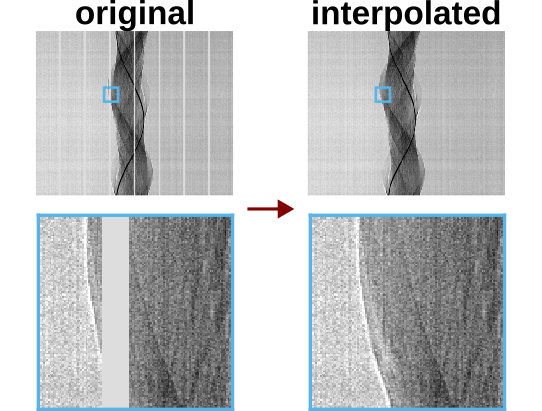
arXiv preprint, 2026
Generative models (WGAN-GP and Pix2Pix) fill the gaps between photon-counting detector tiles, changing only the gap pixels while keeping their intensity statistics realistic. Pix2Pix gives the most natural fills.
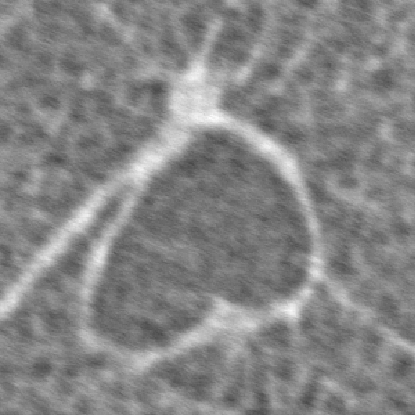
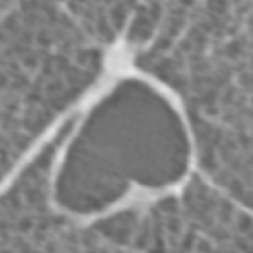 Denoised
Low dose
Under submission
Each noisy projection is split into two subsampled copies with independent noise. Both are reconstructed, and a denoiser is trained on the resulting slice pairs, with no high-dose reference scans required.
arXiv preprint, 2026
A 2D U-Net extracts per-slice features and a 3D decoder fuses them across the volume, giving slice-consistent artifact reduction at managable computational cost.
Journal of Imaging Informatics in Medicine, 2025
A dual-frame U-Net removes sparse-sampling artifacts from CT pulmonary angiograms, improving image quality, reader confidence, and diagnostic performance, which supports substantial dose reduction.
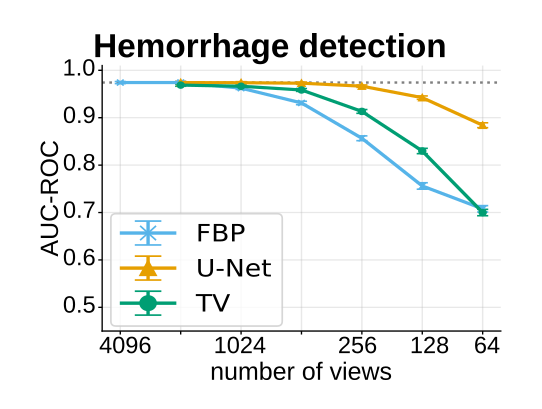
Radiology: Artificial Intelligence, 2024
U-Net post-processing of sparse-view cranial CT keeps automated hemorrhage detection close to full-view performance while using 16× fewer projection views.