Neighbor2Inverse: Self-Supervised Denoising for Low-Dose ROI Phase Contrast CT
Abstract— Propagation-based X-ray phase-contrast imaging (PBI) enables high-contrast visualization of lung structures and holds strong clinical potential. However, safe translation requires substantial radiation dose reduction, which inevitably increases image noise. Supervised Convolutional Neural Network-based denoising can restore image quality but depends on paired low- and high-dose datasets, which are rarely available in practice. Self-supervised methods avoid this limitation, yet most are not well adapted to the inverse problem of PBI computed tomography (CT).
We introduce Neighbor2Inverse, a self-supervised denoising framework for low-dose PBI CT. Building on the Neighbor2Neighbor principle, each noisy projection is subsampled into two variants that preserve structural information but contain independent noise realizations. These are reconstructed separately, and the resulting pairs are used to train a denoising network directly in the reconstruction domain. We systematically investigate multiple framework variants and benchmark against established denoising methods.
In region-of-interest PBI CT experiments, Neighbor2Inverse achieves superior noise suppression while maintaining fine structural details, as confirmed by visual assessment, increased contrast-to-noise ratio, enhanced spatial resolution, and improved composite image quality metrics.
Code and data are publicly available at https://github.com/J-3TO/Neighbor2Inverse.
Under submission.
We introduce Neighbor2Inverse, a self-supervised denoising framework for low-dose PBI CT. Building on the Neighbor2Neighbor principle, each noisy projection is subsampled into two variants that preserve structural information but contain independent noise realizations. These are reconstructed separately, and the resulting pairs are used to train a denoising network directly in the reconstruction domain. We systematically investigate multiple framework variants and benchmark against established denoising methods.
In region-of-interest PBI CT experiments, Neighbor2Inverse achieves superior noise suppression while maintaining fine structural details, as confirmed by visual assessment, increased contrast-to-noise ratio, enhanced spatial resolution, and improved composite image quality metrics.
Code and data are publicly available at https://github.com/J-3TO/Neighbor2Inverse.
Under submission.
Overview of the Neighbor2Inverse method
A - Neighbor2Neighbor approach in projection space. B - Neighbor2Inverse framework: Subsampling in projection space and denoising in reconstruction space. C - Neighbor2Inverse with data fidelity: Introducing data fidelity terms to constrict the denoising process.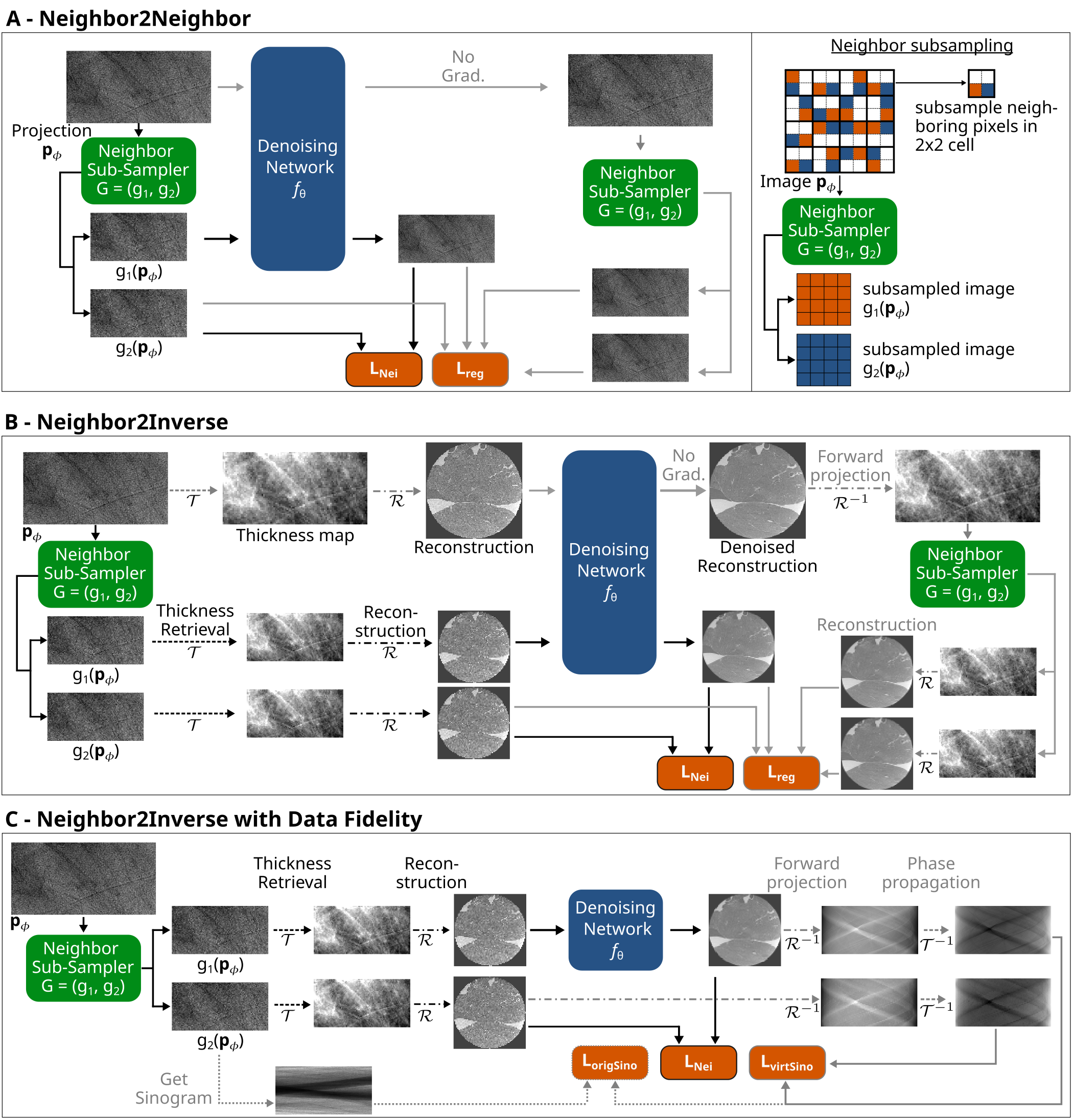
Comparison of denoising methods on reconstructed CT slices
Drag each slider to reveal the Low dose (15ms) image.Comparison of denoising methods on clinical CT pulmonary angiograms
Drag each slider to reveal the Low dose image.Denoising projections (15ms) by various methods.
Drag each slider to reveal the denoised image.200ms
Gaussian Filter
BM3D
ProjFakeNoiseNet
Nei2Nei U-Net L2
Nei2Nei U-Net L1
Nei2Nei KBNet L2
Nei2Nei KBNet L1
Comparison of different Neighbor2Inverse regularization and subsampling strategies
Drag each slider to reveal the denoised image.200ms
15ms
proj. subsampling
LNei+Lreg
LNei+Lreg
proj. subsampling
LNei
LNei
sino. subsampling
LNei
LNei
DataFidelityOrigSino
LNei+LorigSino
LNei+LorigSino
DataFidelityVirtSino
LNei+LvirtSino
LNei+LvirtSino
Denoising reconstructed CT images (15ms - 900 projs.) by various methods
Drag each slider to reveal the denoised image.15ms -
1.800 projs.
1.800 projs.
15ms -
900 projs.
900 projs.
Nei2Nei
proj. subsampling
LNei
LNei
sino. subsampling
LNei
LNei
DataFidelityOrigSino
LNei+LorigSino
LNei+LorigSino
DataFidelityVirtSino
LNei+LvirtSino
LNei+LvirtSino
Denoising results of Neighbor2Inverse with different exposure times and projection views.
Drag each slider to reveal the denoised image.1800 proj.
900 proj.
600 proj.
450 proj.
360 proj.
300 proj.
225 proj.
200ms
100ms
67ms
50ms
33ms
25ms
15ms